
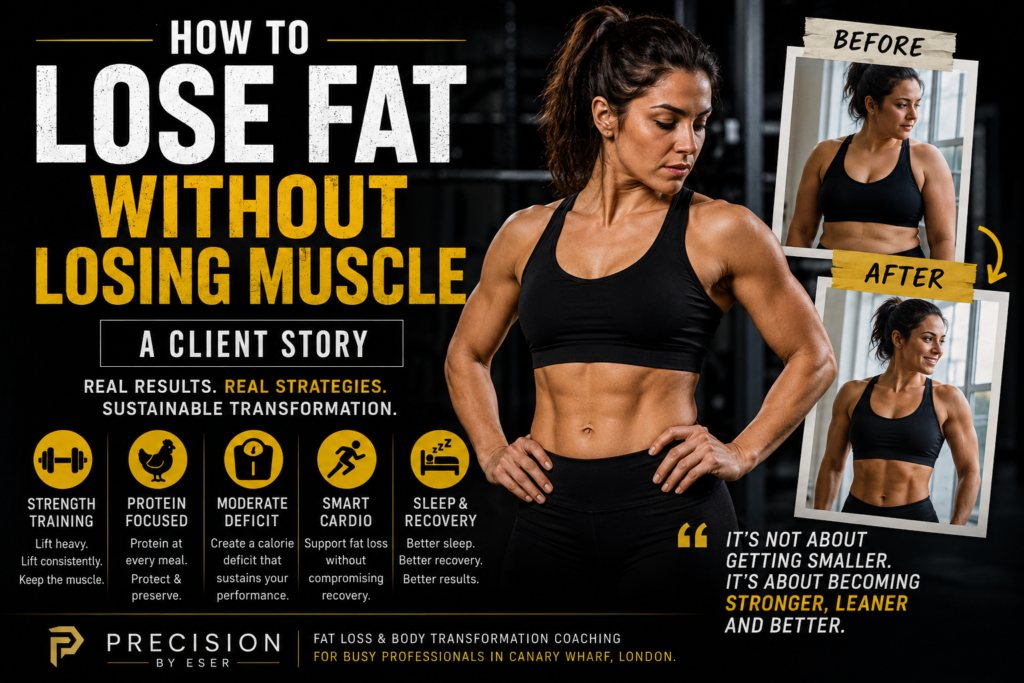
I always tell my clients the same thing when they first sit down with me and say, “I just want to lose fat but I don’t want to look skinny fat afterwards.” I smile, because I know exactly where this conversation is going. Let me tell you about one client who taught me just how important it is to get this balance right.
She came to me a few years into her fitness journey, frustrated. She had lost weight twice before and both times the same thing happened. The scale went down, her clothes got a little looser, but so did her arms, her shoulders, her whole shape. She looked smaller, not leaner. That’s not what she wanted, and honestly, that’s not what anyone really wants when they say “I want to lose fat.”
So we sat down and I explained it to her the way I explain it to every client: losing fat while keeping your muscle isn’t about crash dieting or living on the treadmill. It’s about giving your body a reason to hold onto the muscle you’ve worked so hard to build, while still creating the environment fat loss needs.
The first thing I told her was this: strength training is non-negotiable. Your body doesn’t hold onto muscle out of sentiment it holds onto what it thinks it needs. If you’re lifting weights consistently, your body gets a clear signal that this muscle is being used and has to stay. If you stop training hard, or if you swap your lifting sessions for endless cardio, your body has far less reason to protect that tissue. So we kept her training focused, progressive, and consistent. No random workouts, no skipping sessions because “I’m cutting anyway.” If anything, her lifting became more important during her deficit, not less.
Next, we talked about nutrition, and I always tell clients this part matters just as much as anything happening in the gym. Protein became the anchor of her meals. I told her, “If you remember nothing else, remember this a solid source of protein at every single meal.” Protein protects muscle tissue and supports recovery, especially when you’re eating less overall. It became second nature for her fairly quickly: eggs at breakfast, chicken or fish at lunch, a shake if she was short on time, something protein-forward at dinner.
And then came the deficit itself. She wanted to go hard and fast, cut her calories drastically and “get it over with.” I’ve seen that story before, and it rarely ends well. I explained that a moderate deficit almost always beats a drastic one, because it protects your performance in the gym, your energy throughout the day, and most importantly your muscle mass. A huge deficit might drop the scale faster, but a lot of that speed comes from muscle, not just fat. We found a deficit that let her still feel strong in her sessions, still have energy for her life outside the gym, and still see steady progress week to week.
Cardio came up too, of course. She assumed more cardio would speed things along. I told her cardio has its place walking, some light cycling, maybe a couple of targeted sessions a week but if it starts eating into her recovery, it works against her, not for her. Her main focus stayed on lifting and recovering well, with cardio playing a supporting role rather than the lead.
But here’s the part I think gets overlooked the most, and it’s the part I probably talk about most with my clients now: sleep. She was a classic case training hard, eating well, but only getting five or six hours of broken sleep most nights. I explained to her that poor sleep doesn’t just leave you tired. It increases hunger, it reduces how well you perform in your sessions, and it makes muscle loss far more likely even if everything else is dialed in. Recovery isn’t just a nice extra; it’s part of the plan. So we worked on her sleep the same way we worked on her training and her meals with structure. A proper wind-down routine, a consistent bedtime, less scrolling in bed. Within a few weeks, her sessions felt stronger, and her hunger became far more manageable.
Months later, she wasn’t just lighter on the scale. She looked leaner, stronger, and more defined the physique she’d actually been chasing the whole time, not just a smaller version of her old self. Her lifts had actually gone up in a few key exercises, even in a deficit, which is usually a good sign that muscle is being maintained rather than lost. That’s the difference this approach makes.
What I remember most from that whole process wasn’t a single big change it was how much the small, boring, consistent habits added up. Nobody gets excited about going to bed on time, or eating the same protein source at every meal, or keeping cardio moderate when part of you wants to do more. But those are the habits that actually protect your muscle while the fat comes off. The flashy, aggressive approach almost always sacrifices something, and usually it’s the muscle you worked years to build.
So if you’re chasing the same goal, here’s what I tell every client who sits across from me: lift weights, and lift them consistently. Eat enough protein at every meal. Stay in a sensible calorie deficit rather than a brutal one. Keep cardio supportive, not excessive. And take your sleep and recovery as seriously as your training plan. Do all of that together, and you give your body every reason to burn fat while holding onto the muscle you’ve worked so hard to build.
Precision by Eser
Fat loss & body transformation coaching for busy professionals in Canary Wharf, London.
For coaching enquiries: 🔗
https://www.instagram.com/precision_by_eser?igsh=YWQxaXNucnI5Y2lz