
By Precision by Eser Certified Personal Trainer As a personal trainer
I hear the same question almost daily: “How much protein should I actually be eating?” It’s a great question, but the answers you find online are often a mess. Some fitness influencers tell you to eat a whole chicken every meal, while diet culture whispers that protein is only for bodybuilders.
The reality is that most people fall into one of two camps: they are either drastically under-eating protein or they are massively overthinking it.
This article is designed to cut through the noise. We are going to ditch the confusing math and the bro-science and look at exactly how much protein you need, why it matters and how to actually hit your targets without making your life miserable.
The “Magic” Number: Let’s Get Specific
If you are training regularly and your goal is to change your body composition (whether that means building muscle, losing fat, or both) the science is actually very clear.
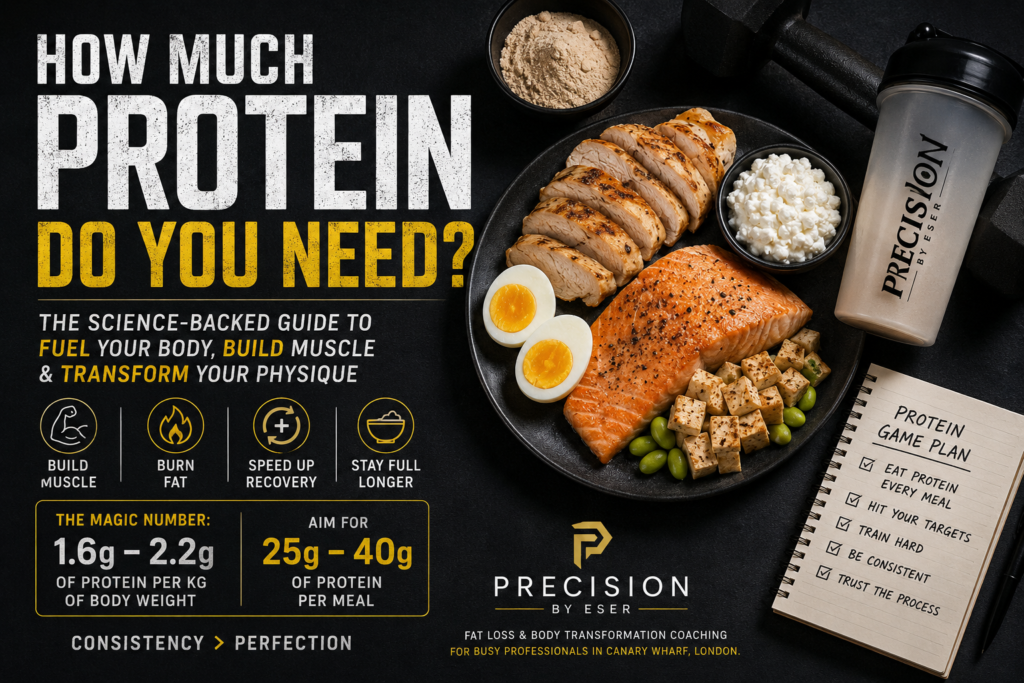
A good, evidence-based rule of thumb is to aim for 1.6 to 2.2 grams of protein per kilogram of body weight.
For those of us who still think in pounds, that translates to roughly 0.7 to 1 gram per pound of body weight.
Let’s do an example to make it simple: If you weigh 75 kilograms (about 165 lbs), your target range is between 120g and 165g of protein per day.
But wait, do I need the high end or the low end?
- Stick to the lower end (1.6g/kg) if you are relatively sedentary outside the gym or are in a maintenance phase.
- Aim for the higher end (2.2g/kg) if you are in a calorie deficit (trying to lose fat), extremely active or trying to maximize muscle growth.
What About “General Health”?
If you don’t care about big muscles or a “shredded” look, you can absolutely go lower. The general Recommended Dietary Allowance (RDA) for protein is about 0.8g per kg of body weight. This is enough to prevent deficiency and keep your organs functioning.
However, if you are reading this article, you are likely working out with me for a reason. If physique change is the goal, protein isn’t just an option; it is the main ingredient for success.
Why Do We Need So Much Protein?
When I ask my clients to increase their protein intake, they often worry about gaining weight or “bulking up” too much. In reality, protein is the most valuable tool in your nutrition toolkit.
Here is why we prioritize it:
- Recovery and Repair When you lift weights or push your body during cardio, you are actually creating microscopic tears in your muscle fibers. Protein supplies the amino acids that act like the mortar to rebuild these tears. Without adequate protein, you are leaving those tears open, which leads to soreness and slower progress. You aren’t getting stronger in the gym; you get stronger during the recovery afterward. Protein is the key to that recovery.
- Satiety (The Fullness Factor) If you are trying to lose fat, protein is your best friend. Your body has to work harder to digest protein than it does fats or carbohydrates. This is called the Thermic Effect of Food (TEF). Eating a high-protein breakfast makes you feel full for hours, reducing the urge to snack on processed junk at 10am. It stabilizes your blood sugar and stops cravings in their tracks.
- Lean Muscle Preservation This is critical for fat loss. When you are in a calorie deficit, your body doesn’t just burn fat; it often burns muscle for fuel too. By eating high amounts of protein, you signal to your body that the muscle is valuable and should be protected. This means the weight you lose is mostly fat, not muscle.
The “One-Meal” Myth
One of the biggest mistakes I see is clients packing their entire day’s protein intake into one massive dinner usually a huge steak or a double scoop of whey. While that is better than nothing, your body doesn’t have a “protein warehouse.” It needs a steady supply of amino acids throughout the day.
The Strategy: Spread your intake across 3 to 4 meals.
- Breakfast: 30g
- Lunch: 40g ·
- Dinner: 40g
- Snack/Post-Workout: 20g
This constant drip-feed keeps your muscle protein synthesis (the process of building muscle) elevated all day long. Aim for roughly 25 to 40 grams of protein per meal.
The Myth of “The Anabolic Window”
You might have heard that you need to slam a protein shake within 30 minutes of your last rep, or your workout was a “waste.” This is simply not true.
The “anabolic window” is a lot wider than supplement companies want you to believe. As long as you are getting a quality source of protein within a few hours of training, you are fine. Is it beneficial to have some protein right after? Sure. But don’t stress if your shake is sitting in your car while you shower. Consistency over perfection is the mantra here.
I Don’t Eat Meat: Can I Still Hit My Numbers?
Absolutely. While animal proteins (chicken, beef, fish, eggs, dairy) are “complete” proteins (meaning they have all the essential amino acids), you can easily hit your targets with plant-based options.
However, you need to be a bit more mindful with portions. Plant proteins often come with more carbohydrates and fiber. Here is the hierarchy:
- Best: Greek yogurt, cottage cheese, eggs, lean meats, fish.
- Plant-Based: Tofu, tempeh, edamame, lentils, chickpeas, quinoa.
- The Supplement: Whey or vegan protein powder is a fantastic tool to “fill the gaps” in your day. Think of it as a tool, not a meal replacement.
The “Cost” Excuse
I know chicken breast isn’t getting any cheaper. But high-quality protein doesn’t have to break the bank. You don’t need to eat steak and salmon every night.
Practical and budget-friendly options:
- Canned tuna or sardines: Cheap, shelf-stable, and packed with protein.
- Whole eggs: One of the most bioavailable proteins on the planet.
- Chicken thighs: Cheaper than breasts and taste better.
- Cottage cheese: An underrated powerhouse.
- Tofu: Usually cheaper than animal meat.
- Canned beans and lentils: Pair with rice for a complete amino acid profile.
Dealing with Fear
I often hear, “But Coach, I’m afraid if I eat that much protein, I’ll get fat.
” Remember: calories matter for fat loss/gain, not just protein. You could eat 300g of protein a day; if your total calorie intake is below your maintenance level, you will lose weight. Protein is the building block; fat is the storage unit. You can’t build a house if you don’t supply the bricks.
The Final Word: Consistency is King
You don’t need to hit 2.2g/kg every single day perfectly. Your body isn’t that fragile.
If you hit 1.6g/kg 80% of the time and 2.0g/kg 20% of the time, you will see amazing results. The issue is when you dip below 1.0g/kg for weeks on end while trying to train hard—that is when you stall.
Stop stressing about getting the exact number to the decimal. Focus on the big rocks:
- Eat a protein source with every meal.
- Prioritize whole foods over processed carbs.
- Use a shake if you’re short on time.
If you weigh 70kg, don’t cry over 5 grams of protein. Look at the 7-day average instead of the 24-hour snapshot.
Your success isn’t defined by one perfect day. It is defined by the 100 “good enough” days that follow.
Quick Reference “Cheat Sheet”
- Your Goal: Build Muscle or Lose Fat.
- Target: 1.6g to 2.2g per kg of body weight (0.7 to 1g per lb).
- Meal Distribution: 25g – 40g per meal, 3-4 times a day.
- The “Secret: Consistency > Perfection.
- Best Sources: Chicken, Eggs, Fish, Greek Yogurt, Tofu, Protein Powder.
Precision by Eser
Fat loss & body transformation coaching for busy professionals in Canary Wharf, London.
For coaching enquiries: 🔗