
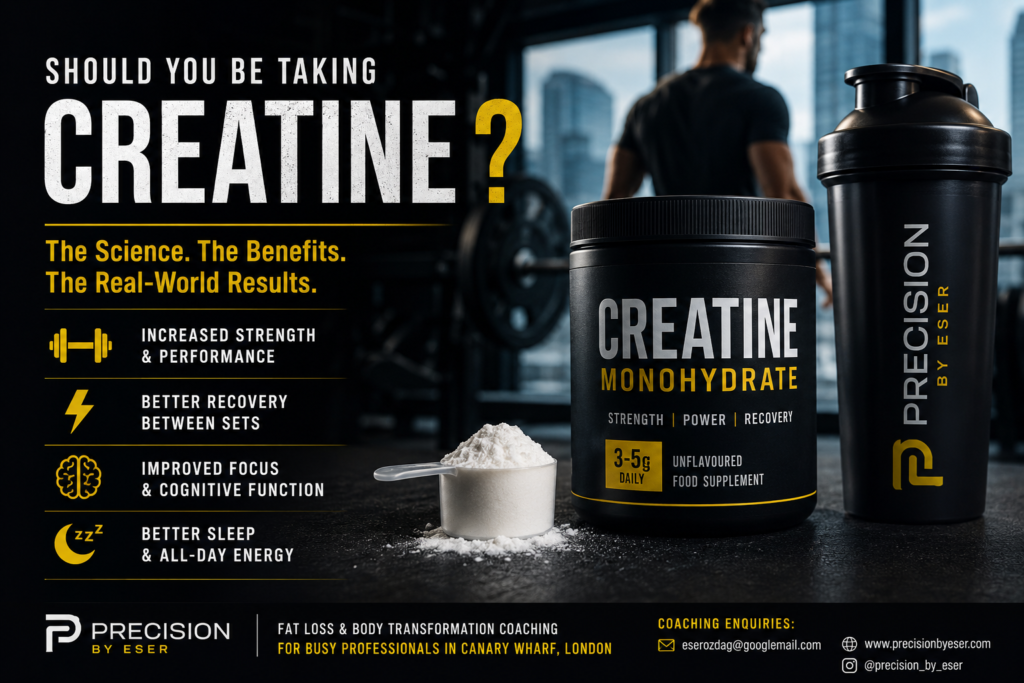
A few months ago, one of my clients, a man in his mid 40s, busy with work and family, training with me to get back in shape, asked me a question I get all the time:”Should I be taking creatine?”
He’d heard mixed things. A friend at the gym swore by it. Another said it was “just for bodybuilders” or worse, “basically steroids.” He wasn’t sure what to believe, and like a lot of people his age coming back to training, he just wanted a straight answer from someone he trusted.
My answer was simple: yes. I told him to start with creatine monohydrate, the most researched and reliable form on the market, and to take it consistently. What happened over the following weeks genuinely surprised even me.
What I told him
I explained that creatine isn’t some new, experimental supplement — it’s one of the most studied compounds in sports nutrition, with decades of research behind it. Your body already produces it naturally and stores it in your muscles, where it fuels short, intense bursts of effort like lifting, sprinting, or jumping. Supplementing just tops up what your body already uses.
I recommended 3 to 5 grams of creatine monohydrate per day, taken consistently with no need to cycle on or off. No complicated loading phase, no special timing just a small scoop with a meal, every day. I told him to expect it to take a few weeks to really kick in, since muscle stores build up gradually without a loading phase.
What actually happened
Within about three to four weeks, the change was hard to miss. He was lifting heavier across the board not dramatically, but steadily, week over week, in a way that wasn’t happening before. He had more in the tank for the last few reps of a set, which is often where real progress gets made.
But the part that stood out most to me wasn’t even in the gym. He told me his sleep had improved, and he was waking up feeling more rested. His energy throughout the day was noticeably better less of that mid-afternoon slump, more consistent focus at work. For a middle-aged client juggling a demanding job and family life, that kind of full-day energy shift mattered just as much to him as the strength gains.
This lines up with what the research actually shows. The benefits of creatine go beyond pure muscle performance:
Increased strength and power output, supporting better training adaptations over time as muscle creatine stores rise.
Improved performance in short, intense efforts lifting, sprinting, repeated sets where stored creatine gets used directly.
Better recovery between sets, meaning more productive training sessions instead of fading halfway through.
Improved cognitive processing, particularly when fatigued which may explain part of why my client felt sharper, not just stronger.
Memory support in older adults a 2023 study published in Nutrition Reviews found a significant improvement in memory among adults aged 66–76, suggesting benefits well beyond the gym.
Emerging interest in long-term brain health, an area researchers are actively exploring, though it’s still early days.
Is creatine actually safe?
This is usually the next question, and it’s a fair one. The short answer: yes, for the vast majority of healthy adults, creatine is one of the safest supplements available. A review covering over thirty years of research found that creatine monohydrate is safe for most populations at recommended doses, with no supported link to kidney damage or cancer in healthy individuals. Claims about dehydration or cramping during exercise are also largely unsupported by controlled studies.
The most common side effect is mild stomach discomfort, and even that tends to be dose-dependent rather than something everyone deals with. If it comes up, spreading the dose across the day or taking it with food usually sorts it out.
A few honest caveats worth mentioning: anyone with an existing kidney condition should check with their doctor first, since most research has focused on healthy individuals. Safety during pregnancy and breastfeeding hasn’t been established either, so it’s best avoided there. And for anyone competing, no need to worry — creatine isn’t on any prohibited substances list.
Frequently Asked Questions:
Should I be taking creatine?
For most healthy adults, yes. It’s one of the few supplements where the research consistently backs up the results better strength, better recovery, and in some cases, better energy and sleep too.
How much creatine should I take?
3 to 5 grams of creatine monohydrate daily, taken consistently. No loading phase required.
Does creatine cause hair loss?
The evidence doesn’t support this. The concern stems from one small study measuring a hormone loosely linked to hair loss, not actual hair loss — and nothing since has confirmed a direct connection.
How long does creatine take to work?
Without loading, expect roughly three to four weeks to notice a difference. With a loading phase, results can show up within about a week.
Is creatine only for younger athletes or bodybuilders?
Not at all. My client’s experience is a good example of middle-aged, training to get back in shape, and the benefits showed up in strength, energy, and sleep, not just muscle size.
The bottom line
My client’s story isn’t unusual — it’s actually a pretty typical response to creatine when it’s taken consistently and at the right dose. Better lifts, better recovery, better sleep, more energy throughout the day. If you’ve been on the fence about whether creatine is worth it, the science says yes for most healthy adults, and in my experience training clients, the real-world results back that up too.
If you’re unsure whether creatine is right for you, especially with any existing health conditions, check with your doctor first and if you want guidance on dosing and timing that fits your training, that’s exactly the kind of thing I help clients with.
Precision by Eser
Fat loss & body transformation coaching for busy professionals in Canary Wharf, London.
For coaching enquiries: 🔗
https://www.instagram.com/precision_by_eser?igsh=YWQxaXNucnI5Y2lz